

Investing in AI is evolving from a traditional growth investing paradigm—where revenue growth, market size, market penetration, and moats rule the day—to a macro trade, where public policy, government spending, and even foreign exchange considerations play a role in determining investment success. This has critical implications for investors: it's going to be more difficult to value companies, especially those planning to IPO in the coming months. A downturn in AI stocks can come from unexpected directions: new economic, social, or political developments can present risks to revenue growth, market penetration, and competitive dynamics. What is an investor to do?
Traditional growth investing is simple to describe, albeit hard to do successfully: find companies that are consistently growing, ideally likely to outgrow incumbents, who have a good chance to either become the new incumbent or one of a few market leaders in the space. If the companies are founder-led, have subscription-based business models, and meme-stock potential, then even better.
Of course, picking the right growth investments from hundreds or thousands of companies is incredibly difficult. This typically involves focusing on the industry and understanding the company, its peers or competitors, and its customer base. In some ways, it's an insular process—you do not need to worry about much outside of the specific industry and market the company focuses on. Public policy, foreign exchange, political priorities and pressure against companies aren't typically things one has to analyze.
Macro trading demands awareness of broader macroeconomic trends, economic considerations, and even politics and public policy. The instruments you are trading—bonds, currencies, stock market indices, certain energy and commodity contracts—have significant exposure to government policies and decisions, and hence you need to be very aware of them.
This is where the AI trade is now at. AI companies, infrastructure buildouts, and market potential are so large that governments can't ignore them; in fact, in some cases companies are competing with governments for access to debt markets. Geopolitics plays a role, too—sanctions, tariffs, and regulatory hurdles are being introduced to protect the companies that governments assume will be the winners in this industry. Citizens are playing a more active role, as seen with opposition to data centers, concerns about energy costs, and fear of impending and long-term job losses.
Welcome to the macro trade.
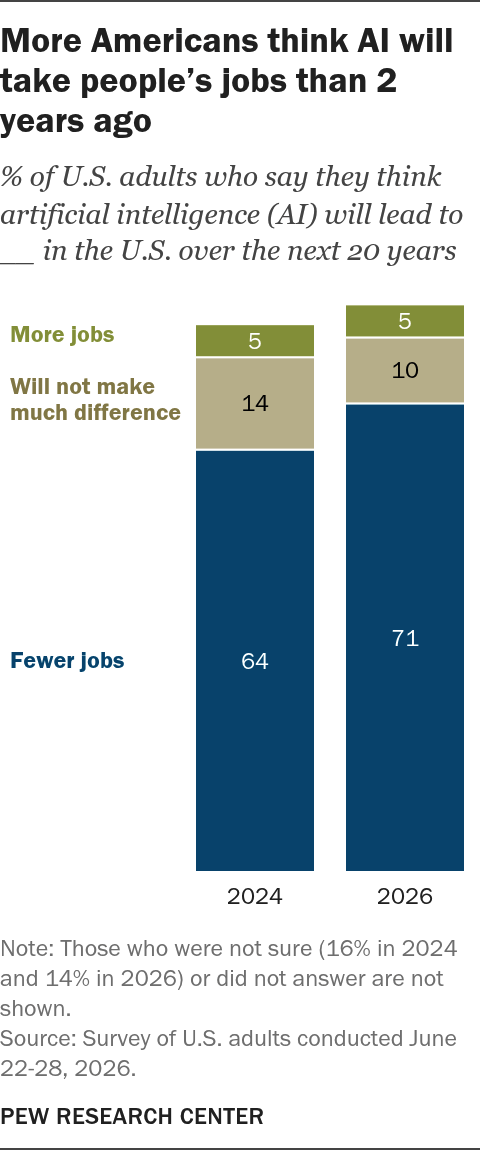
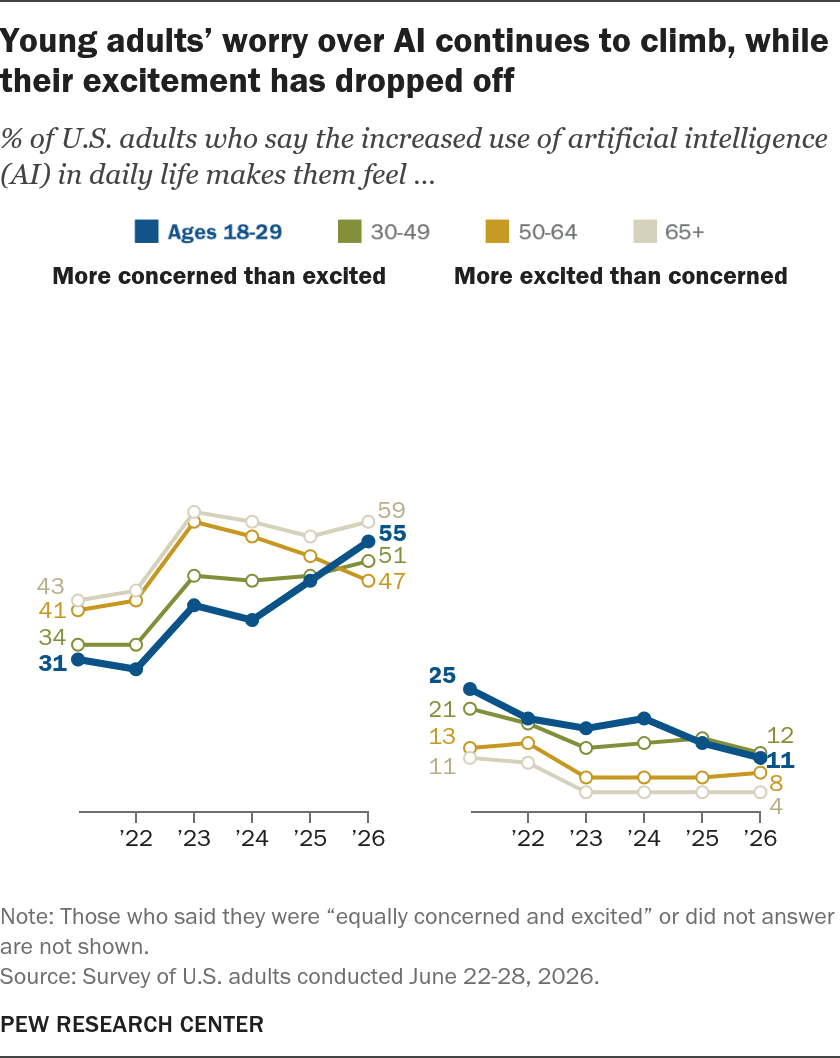
Let's begin by looking at public discourse around AI, and the risks this might introduce to the AI macro trade. Sentiment around AI is getting more negative over time, with people across all age groups worried about its impact on them and on society. As shown in Figure 1[1], 71% of people think AI will reduce jobs over the coming two decades, up from 64% in 2024. Those between 18 and 29 have seen the largest increases in negative sentiment toward AI in the past two years, as shown in Figure 2.
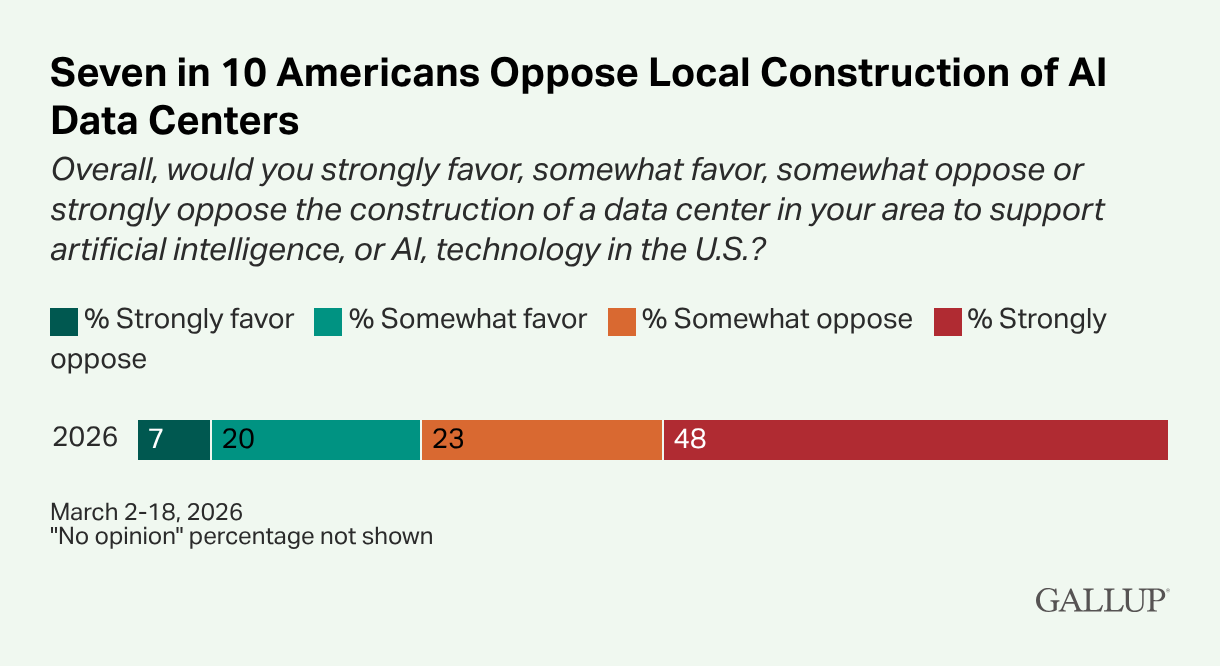
Ambivalence and fear are driving opposition to data centers; 7 in 10 Americans (see Figure 3) oppose data center development in their communities.
Is AI the new social media? The new smoking? Something altogether different?
Politicians are taking note; with 2026 being a high-stakes US midterm election year, they can't afford not to. In July, New York State imposed a data center moratorium[2], pausing new data center approvals for the coming year. Pennsylvania increased requirements on data center approvals last week[3]. Even Texas, seen as a bastion of data center positivity and free market chutzpah, paused over 1,800 data center projects due to concerns around water and energy usage[4].
AI provides a decent scapegoat for poor jobs data, rising inflation, and other challenges Americans are facing. The US midterms in three months will further exacerbate these concerns and force politicians' hands. Given how aggressive AI capital expenditure is planned for the rest of 2026 and into 2027, simply delaying project approvals or construction kickoffs can hamper neoclouds, startups, and hyperscalers. As we discuss in earlier writing, circular AI deals that use backstops, lease arrangements, and scheduled bond repayments can become significantly riskier if plans are delayed or projects potentially canceled; doubly so if revenue starts stalling.
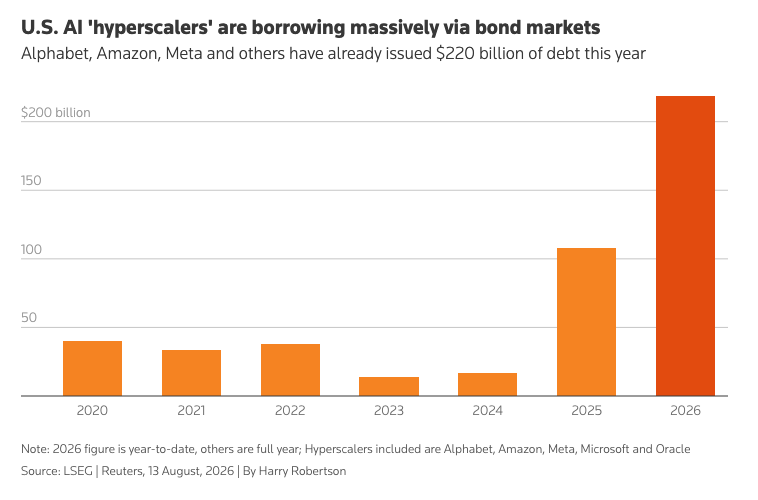
Hyperscalers are issuing more bonds than ever before, with $220 billion issued in 2026 so far[5]—more than double 2025's numbers, as shown in Figure 4. Bonds need buyers, and more bond issuance typically leads to higher yields; in other words, if you can't find a buyer, you increase the interest you pay until you do or until you give up.
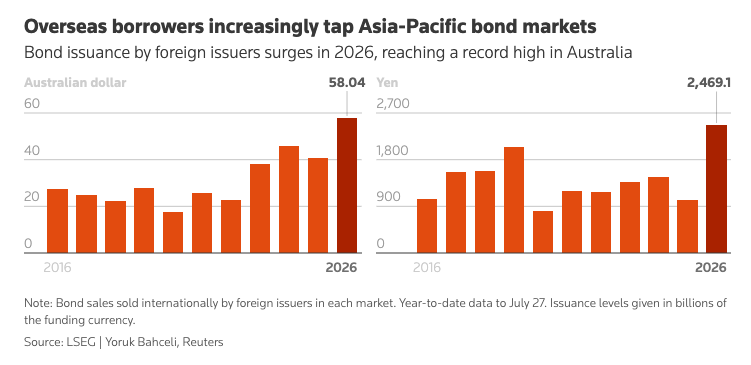
The problem is that the bond market is finite, and moving to a buyer's market increases yields for everyone. There's evidence that the magnitude of AI bonds is beginning to crowd out other bond issuers[6]. To assuage these concerns, companies are also diversifying their issuance—selling bonds in Canada[7], Australia, Japan[8], and more. Bond issuance by foreign companies is hitting all-time highs across countries like Australia and Japan, as shown in Figure 5.
It's possible that higher AI bond issuance is crowding out government debt as well—and could be part of the reason why government bond yields are rising. Think of it this way: if you're a long-term investor, who would you trust to be more diligent with their budget and bond payments—a government with a 5% annual budget deficit, or Alphabet and Nvidia?
What is a government to do? The scenario where hyperscaler bonds crowd out government bond sales can lead to an aggressive response by governments; another macro trading risk. While governments and hyperscalers have a relatively good relationship these days, things can sour if hyperscaler bonds lead to higher government borrowing costs or start to depend heavily on policies related to data center buildouts or other issues discussed in the Political and Civic Opposition to AI section above. Imagine if Treasury Secretary Bessent needs to decide whether to bully hyperscalers to borrow less, or increase yields on long-term US Treasuries.
Given the stakes in AI, government policy is increasingly impacting corporate strategy. Anthropic launched Fable 5 in mid-June, then quickly removed access due to the Trump Administration's export controls[9]. Export rules have prevented Nvidia from selling leading-edge chips to China since the Biden Administration[10]. Apple was warned not to buy Chinese memory chips[11]. This can affect pricing in the case of Apple, or actually remove product offerings completely, as seen with Fable 5.
Revenue is so high, and shortages so intense, that countries are developing their own “sovereign AI” strategies to protect their capabilities now and into the future.
It's impossible to summarize geopolitical AI developments in a short essay, so we'll leave a few observations to help illustrate how quickly this space is changing—and how it is likely going to impact the underlying fundamentals of the companies themselves:
In summary: there's a good chance the current players will not be the only ones or the main ones in a few years' time. It's even possible we'll have more open models, an ecosystem that is less dependent on just a few players, or complete fragmentation. How regulations evolve, whether sanctions play a role, and how this is all enforced will play an increasingly important role in determining the companies that thrive or suffer.
The AI trade is beginning to look like a macro trade. Government policy, civic discourse, military developments, and other geopolitical factors are playing a role in how companies succeed or fail. In addition to looking at traditional tech-oriented metrics like annual recurring revenue, market penetration, and growth thereof, it's important to further track additional features and strategies of these companies:
Of course, we believe frontier AI is here to stay, but how you diversify, protect your assets, and succeed as an investor is changing.
Join hundreds of AI, geopolitics, and economics experts. We'll send 1–2 emails per week, and we will never share your e-mail with anyone.



.svg)
