
There are thousands of articles and opinion pieces on Situational Awareness: what happened, what went wrong, and so on. We're less interested in exploring that here as you can find lots of deep dives and many more to come, we're sure.
Contrary to what others say, we believe that Situational Awareness struggled this past week because of forces pushing prices down, but it also benefited from those same forces when its asset prices were skyrocketing in value over the past ~18 months. Situational Awareness is more of a canary-in-the-coal-mine situation than a divergence from a positive trendline. SA's rise and fall shows that the AI-related stock market is over-leveraged and over-concentrated, and will most likely lead to significant volatility in the coming months. Call it the KOSPIfication of the NASDAQ.
Here, we'll explore why Citadel buying SA's publicly traded assets is neither bullish nor bearish, and why the same market forces (excitement, leverage, overconfidence) not only drove SA's asset prices down this past month, but also were the reason for them going up. This is all in the context of a reflexive trend, and one aligned with our concerns around US household, retail, and hedge fund leverage[1]—the deleveraging of which, and the fear associated with loss of paper wealth, would lead to a significant negative feedback loop for AI assets.
Some writers have argued that Citadel's purchase not only saved the market, but signals Citadel's own confidence in the AI trade. This is incorrect. Citadel might be using this to cover shorts, sell put options, or resell the securities directly to retail traders, given its market-making relationships with firms like Robinhood. Given Citadel's size and diversity of business offerings, from running funds through to market making, it could very well be a combination of these.
A key benefit of the purchase was that it was done as a block purchase; SA did not submit a set of sell orders via its broker to liquidate itself, unlike the rumor that SA was selling off Intel after its earnings[2]. The block trade serves to stem a further price shock, and could even allow Citadel and SA to avoid pricing individual positions or companies.
For all we know, it might have been a form of short covering for Citadel, or maybe arresting a decline in some of its or its clients' holdings… Maybe a strategy to manage price declines not unlike what we saw in China about two weeks ago[3].
Our goal is not to speculate on Citadel's objectives, but rather to simply say there are many interpretations that do not signal this as a positive long-term view on AI stocks held by SA.
While SA blamed short sellers betting against its own positions[4] (and thus Citadel could be helping with short covering, as per above!), these same forces are likely what propelled SA's skyrocketing returns in the first place.
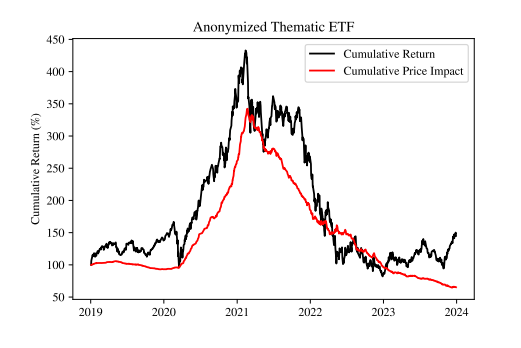
Philippe van der Beck (from Harvard Business School), Jean-Philippe Bouchaud (from Capital Fund Management, CFM), and Dario Villamaina (from CFM) explored how thematic ETFs can benefit from their own success by driving the price of their assets up[5]. The details of the paper are outside the scope of this note, but there are a few forces at play. For example, a successful ETF is likely to get more investors buying its shares, and these influxes of cash allow the ETF's portfolio managers to double down on their positions. This can lead to a positive feedback loop around the ETF's assets, thus driving up the prices of earlier purchases and leading to a net gain on the investments. This is particularly true for illiquid stocks and concentrated industries (both of which SA was focusing on), as there are fewer shares to go around. Figure 1 shows one of the funds they investigated, whose path of price increases and asset growth looks strikingly like SA's—up about 400%, then a significant decline.
While SA was a hedge fund, the fact that it avoided the use of actual hedging strategies and its high correlation with other public ETFs (which also avoid hedging strategies) like the iShares Semiconductor ETF (SOXX) mean it likely acted more like a public ETF than a hedge fund.
In short: our argument here is that regardless of whether there was a targeted short seller campaign against SA, SA exhibited the sort of growth and decline that you would expect from an over-leveraged and unhedged index tracking a megatrend. It was a beneficiary and victim of its own success, and there are likely other such risks lurking in the public equities AI market today.
This points to another phenomenon aligned with what van der Beck et al. explored above—George Soros' theory of reflexivity[6]. Soros argued that investor expectations and perceptions can become so prevalent and powerful that they begin impacting the actual fundamentals of the underlying asset classes those investors buy. The liquidity inflows in the ETF example above are a simple version of this. Circular AI investments[7], wealthy investors leveraging their wealth to get further profits from an already stretched stock market, and CEOs who believe the AI trade can only benefit their companies if they invest more and further, are all examples of reflexivity in action—these beliefs lead to investments, capital expenditures, and other decisions that drive asset prices up, sometimes in ways that maintain P/E ratios or other warning signs asset managers tend to monitor[8].
Like van der Beck et al., Soros argued that such forces help propel positive price movements, but also end up making price declines more violent. This should translate to significant volatility in price movements, both on the way up and down.
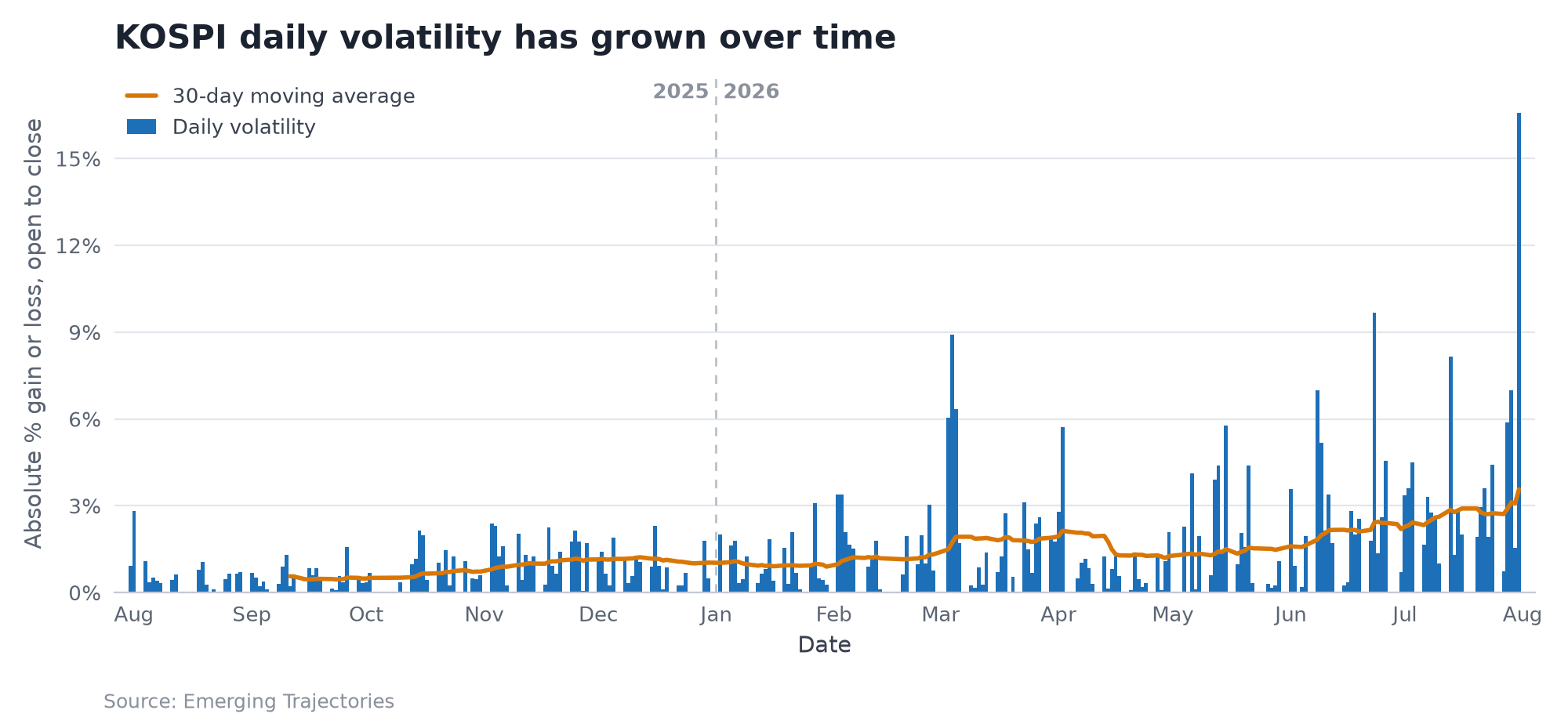
We saw this in action over the past week, when the KOSPI fell 17.8% from an open of 6,806.27 on Monday to 5,593.56 on Thursday end-of-day, before recovering 17.9% on Friday, all while declining 3.1% over the week[9]. Looking back over the past year, as in Figure 2, you'll see that the KOSPI's daily price movements from when it opens in the morning have become significantly more volatile.
We would add another sociological component to this: the vast majority of wealth growth today is from stock markets[10]. Thinking like a normal human being: if your wealth is tied to the stock market and the stock market starts dropping in value, you'll likely want to protect your assets by selling those shares. Large downward stock movements can exacerbate selloffs when panicked savers decide to move money to safer assets.
All-in, whether it's leverage, fear of wealth loss, or actual reflexivity, the volatility of this past week—and the demise of SA—are all related and we expect them to continue as AI-related stocks, bonds, and other assets appreciate so much in value.
Our goal today is not to criticize Situational Awareness—raising a billion-dollar hedge fund is very hard, and scaling it to $10 billion+ AUM is laudable. There are many professionally managed funds that are liquidated despite their managers' best efforts.
What concerns us is the lack of a “bigger picture” discussion around Situational Awareness; Citadel buying up SA's assets is certainly not the whole story. The bigger picture is that markets are over-leveraged, over-concentrated, and potentially shifting from euphoria to fear on a whim.
This all happened in the same week that the Federal Open Market Committee (FOMC) held interest rates at 3.5% to 3.75% and led to significant market concern around the Federal Reserve's future decision-making[11], and news came out of China's success in building home-grown chipmaking tools[12], all of which could move these markets on their own.
With Situational Awareness, we're seeing AI-related asset prices reinforcing themselves on the way up and on the way down. As such, we're likely to see more volatility in US markets, and more days where a deleveraging of a fund or ETF takes place. Regardless of where we end up relative to Friday, expect more and bigger up days and more and bigger down days.
Join hundreds of AI, geopolitics, and economics experts. We'll send 1–2 emails per week, and we will never share your e-mail with anyone.



.svg)
