
This past week's US-Japan collaboration on shoring up the Japanese yen leads to the question—what's wrong? Why is the Japanese yen getting so weak, and is there something wrong with the Japanese economy?
Japan has one of the largest debt-to-GDP ratios and is particularly disadvantaged due to the Iran War driving up oil and energy prices. At the same time, its technology industry has a lot to offer, but not without tradeoffs. Here, we're exploring some of those tradeoffs: interest rates versus debt, investing in the future while managing concerns about overspending, and managing national ambition alongside consumer price concerns.
A full-blown overview of Japan's economy is beyond the scope of our writing. Instead, we'll list some of the larger challenges and initiatives tied to Japan's economic development before exploring the tradeoffs.
Japan has one of the largest debt-to-GDP burdens in the world, at over 200%. Prior to last week's US-Japan currency intervention, its currency lost over 10% of its value this year. Prime Minister Sanae Takaichi is working on a growth-oriented agenda, but facing challenges as inflation hovers at 1.7% and peaked at 3.7% in May 2025[1]. Worse still, a 1.7% inflation rate hides the challenges faced by Japanese consumers: food prices have increased 3.2%, with fish and seafood growing at 6.9% this past year[2]. While fuel and energy prices have been flat, this is only because they are actively subsidized by the government.
Against the inflation backdrop, Prime Minister Takaichi's approval rating dropped from 69% in June to 57% in July. Specific criticisms target her attempts at fighting cost-of-living price rises, with 71% disapproving of her administration's strategy[3]. The challenges are partly out of Japan's control: global energy prices have skyrocketed, leading to significant increases for energy imports.
This is the context that Japan's government finds itself in, and many of its options come with painful pros and cons.
Japan's official interest rate is set to 1%, which was reaffirmed in the July 30/31 Bank of Japan meeting[4].
Higher interest rates should help reduce inflation[5] and encourage more saving. More importantly, higher interest rates reduce the benefit of the carry trade, where investors borrow in Japanese yen (paying the relatively low local interest rate), sell the yen by converting it to other currencies, and then buying international assets. This enables investors to benefit from low Japanese interest rates while arbitraging higher rates and returns elsewhere. Since such investors sell yen, they drive the price of the yen down, which increases costs of other imports, like energy and food.
While increasing interest rates is seen as the sensible central bank policy, there are issues with this. First, higher interest rates also increase the cost of borrowing for consumers—mortgages, car loans, and other products become more expensive, potentially driving further dissatisfication with Takaichi's policies.
Secondly, higher interest rates lead to lower valuations for existing bonds, as yields need to match what bond buyers get in the markets today. This can lead to losses on bonds already purchased. Japan's four largest life insurers have lost about $96 billion in Q2 2026 based on current rises in interest rates[6]. While consumers can be forgiven for not shedding a tear for trillion-yen corporations, losses driven by interest rates were why Silicon Valley Bank collapsed in 2023[7]. Raising rates slowly could be the lesser of two evils.
The Takaichi administration is driving policies that help reduce day-to-day costs for consumers. It is aiming to reduce tax on food from 8% to 1% as of April 2027[8], which will cost about $32 billion[9]. To ensure high oil prices don't translate to significant consumer price increases, the government has been releasing oil from its reserves to cap gas prices at ¥170/liter, and further earmarked $19 billion to subsidize fuel costs[10].
All of the above drives increases in debt. Japan's current year government budget is at $780 billion, and $83 billion (10.7%) of the budget goes to paying interest on its current debt[11]. These costs are expected to rise about 50% over the coming years[12]. When accounting for debt servicing and debt rollovers, Japan's government is spending 25.6% of its budget to service and manage its debts[11].
Paying for tax reductions, subsidies, and other consumer-friendly policies is expensive and risks making the debt worse. This is why some economists and columnists[13] worry that Japan risks a “Liz Truss” moment where bond prices tank and yields soar due to its inability to manage its debts.
Japan is heavily reliant on energy imports, which drive the price of the Japanese yen down—this is one of the reasons the US and Japan intervened in the currency in late July as discussed in our other post. More imports drive yen values down, which increase prices for consumers and businesses buying those imported goods and services. The antidote? Export more or become more reliant on internal production.
How can Japanese industry work to offset the balance of trade challenges the country is facing?
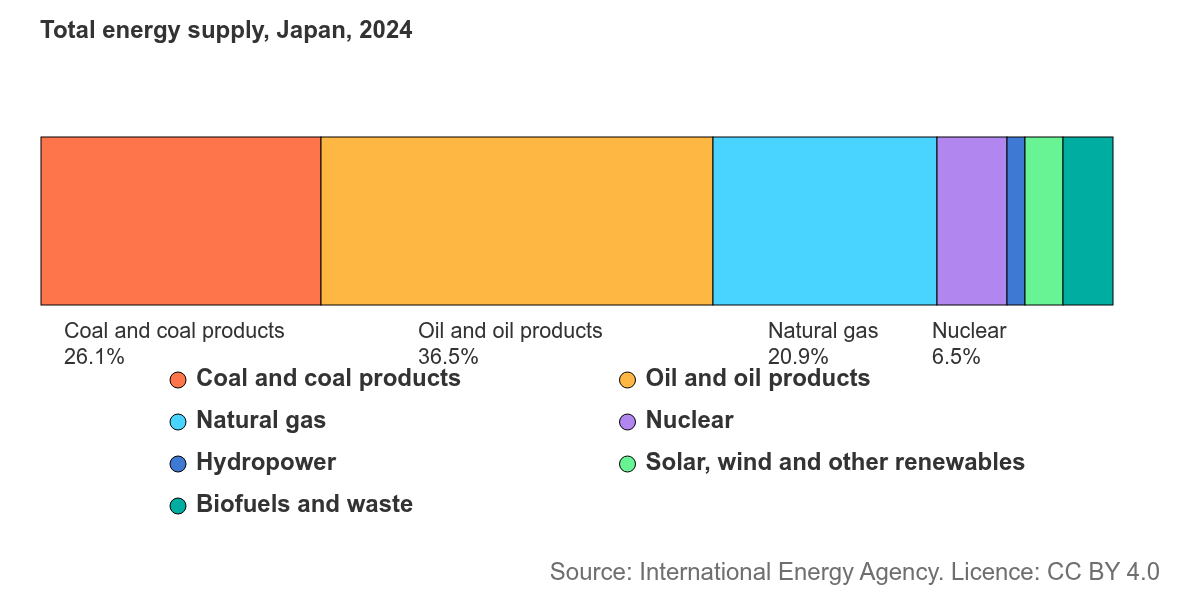
Let's start with energy. The US-Iran war, and resulting resource price spikes, have been particularly painful for Japan. Figure 1 shows Japan's total energy supply[14]. 83.5% of Japan's energy supply is from oil, coal, or natural gas, most of which is imported and typically priced in US dollars or other currencies. This is also slowing down Japan's growth rate[15].
Nuclear power was generally seen unfavorably after the Fukushima disaster of 2011. Surprisingly, Japan also has very low solar power uptake. The government is now arguing for nuclear power development to generate as much as 20% of Japanese power by 2040[16].
It's surprising the number isn't higher, but either way, it will be expensive to get there—and will likely require government subsidies, planning, and other support.
The same applies to defense, with the Japanese government promoting its military buildup—where spend is approaching 2% of GDP—as a way to enable further economic growth and exports. Japan now produces Patriot missiles[17] on behalf of the US, and has loosened defense export policies[18] to enable exports of arms and military equipment. This is strategically important for countering China, and also helps with the balance of trade challenges, driving exports to help the Japanese yen appreciate.
This vision goes further and gets more ambitious. In June 2026, the Takaichi administration proposed a $2.3 trillion public-private investment strategy planned until 2040[19]. The plan[20] covers 17 strategic sectors, from defense and energy to quantum technologies, AI and semiconductors, food, and more. The idea is to invest in various future technologies to make Japan less reliant on imports, grow its exports, and generally outgrow its debt obligations.
It's an exciting plan, and like energy and defense, the major concern is around how this will be financed—and whether bond markets will be supportive. This new trillion-yen strategy is not part of the current budget, so will require more funding and more debt.
This is a particular challenge if the Takaichi administration's popularity wanes further or loses power altogether; in our opinion, one of the worst blunders is to start implementing such a ~14-year growth strategy only to lose political will and economic wherewithal 2 or 3 years into the implementation.
Japan is at a crossroads. Inflation, debt, energy prices, defense spending, and long-term ambition versus short-term economic constraints put it in a difficult bind. The support for the Japanese yen covered in our other post (How Japan and the US Supported the Yen Last Week) was not meant to be a long-term solution, but a way to buy Japan some time.
Prime Minister Takaichi's approval ratings are down significantly from June. There are numerous options for Japan in the coming weeks to begin implementing its vision. The Iran War is driving energy prices up—and this problem might be addressed with negotiations between Iran, Oman, the US, or others. The Bank of Japan's next meeting on interest rates is in September. The timing was right for an intervention, buying Japan time to continue executing on its current plan.
This will not be an easy period for the country—and doubly so for its government—but promises to set Japan up for an exciting long-term growth trajectory. The risks, of course, are if any of this slows down—the Takaichi administration losing popular support, a run on bonds, or longer-term continuations of the Iran and Ukraine wars all risk throwing Japan off its course.
Join hundreds of AI, geopolitics, and economics experts. We'll send 1–2 emails per week, and we will never share your e-mail with anyone.



.svg)
