
This past week, the US and Japanese governments worked together to support the Japanese yen, increasing its value from about ¥164 per dollar to ¥158[1][2][3]. Much has been written about the intervention, and we won't be arguing whether it was good, bad, right, or wrong; our goal is to understand the actual mechanics of propping up the yen, and what we can learn when observing future interventions.
Estimates say that Japan spent $53-$59 billion to support the currency[2][3], and we'll likely learn about the US's intervention numbers in the coming weeks. US Treasury Secretary Bessent's infamous “to do list” note to buy $5B-$10B of yen isn't clear on whether this was a direct purchase or whether other approaches were taken. Following these rumors, the US sold euros to support the Japanese currency[4].
In direct currency transactions meant to manage the Japanese yen's exchange rate, the Ministry of Finance (MoF) will do so via the Foreign Exchange Fund Special Account (FEFSA). In this case, the MoF will manage the strategic decision-making and the Bank of Japan (BoJ) will act as the agent for the transactions. Similarly, if the bank needs to make foreign currency transactions, it will do so via a request to the MoF[5].
The Ministry of Finance pays for the above from its foreign currency reserves[6], and will eventually publish its formal intervention announcements on its site[7]. Interestingly, this monthly release was scheduled for July 29, so the latest intervention won't be published for another month. Similarly, the Ministry's reserves only show a $377 million drop, implying the settlement of the trade took place in August. We'll likely get confirmation of the intervention in several weeks or months; it was only on August 6, 2026 that Japan confirmed its May 2026 intervention to the tune of $74 billion[8], though one could observe a similar magnitude shift in its foreign reserves back in its June report.
The MoF, via FEFSA, tends to buy Japanese yen when it is valued too low by the MoF's standards, and will sell it “high” when there is a recovery or values are too high; this is the purpose of supporting the currency. This has made FEFSA a very profitable trader[9], potentially sitting on $330 billion in cumulative P&L as of the end of 2025.
FEFSA operations are, of course, how the Japanese government directly intervenes in currency markets. Managing the exchange rate via debt issuance, interest rates, or the trade balance are outside the scope of this post. The Japanese government can also encourage (or, via changes to laws, force) Japanese companies to buy more yen. For example, forcing companies to repatriate earnings to Japan[10], forcing pensions and insurance companies to invest more in Japan[11], or even encouraging citizens to open US dollar savings accounts. India recently began offering high-yield dollar accounts and has obtained $40 billion in deposits[12]. For a discussion around these opportunities and tradeoffs around the economy, see our other post from this week (The Tradeoffs Facing Japan's Economy).
The US has several ways to intervene in the currency market, the first of which is to directly buy the foreign currency on the open market. This drives demand for the target currency up, but also drives the price of the US dollar down.
The primary approach the US can use is via the Exchange Stabilization Fund (ESF)[13]. The Department of the Treasury can directly buy or sell currencies via the ESF. It can also trade currency futures or swaps instead[14], though it appears this was not the strategy used at the end of July[4].
The Federal Reserve also has the System Open Market Account (SOMA), which manages foreign exchange reserves and can be leveraged to achieve “the Federal Reserve's macroeconomic objectives.”[15]
In both the ESF and SOMA cases, the US focuses on two currencies: the yen and euro[16]; it does not actively hold balances of other currencies in its reserves.
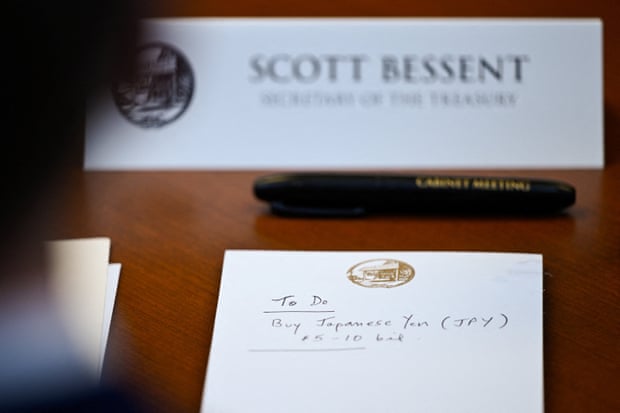
Central bankers, treasury secretaries, and other government finance professionals are astute managers of expectations. If investors or speculators expect something to happen, this can also help manage the currency in question. Given the power of the US Treasury, simply signaling the willingness to intervene, when credible, can drive markets in the direction the Treasury wants. Figure 1 shows the infamous “to do” list that Secretary Bessent left reporters to photograph. While you can't always depend on such expectations driving objectives, it's a useful tool in the US financial arsenal.
Evidence suggests that this signaling and the relatively small US intervention was enough to change how currency traders operated. Bearish positions on the yen fell from 138,000 at the end of June to 63,600 on August 4[17][18]. The fact that the MoF and US Treasury have both been actively managing the yen-dollar exchange rate will likely continue impacting trader decision-making in the near future.
Beyond direct intervention by the US, there are lines of support that Japan can draw on should it need to avoid managing its own foreign reserves or domestic actors (i.e., companies, investors, and citizens).
One option is using the Foreign and International Monetary Authorities (FIMA) Repo Facility[19]. FIMA allows central banks to directly exchange their US treasuries for dollars, which they can use to sell and prop up their currencies, without selling the treasuries on the open market. Japan is not using FIMA for this intervention[20], but Secretary Bessent did call for increasing the maximum amounts to lend via FIMA[21]. This allows the foreign nation to move its currency values without directly selling US treasuries.
The second option is via Central Bank Swap Arrangements[22], where the Federal Reserve lends US dollars to (in this case) Japan, using the Japanese yen as collateral. As with the program above, this allows countries to maintain their exchange rate objectives without needing to sell large amounts of dollars or treasuries or other assets on the open markets.
The challenge for the US is one of coordination with Japan. On the one hand, Japan selling US dollars for Japanese yen drives down the value of the US dollar. Selling treasuries to fund this drives down the value of said treasuries, and drives up long-term borrowing rates for the US. FIMA and swap arrangements allow countries to support their own currencies without directly impacting the US's assets, by effectively using the Federal Reserve as a lender. Across the board, these types of approaches are limited—if the yen continues to decline in value, there's only so much money in swap lines and FIMA that can be obtained. For example, Japan's May 2026 intervention at $78 billion would go well over the current FIMA limits, making it impossible to use in the future.
Hitting the FIMA limits could further change currency traders' expectations about future interventions, since the Bank of Japan would not be able to use this program in the future. Traders would question why the MoF avoided or was forced to avoid selling its reserves, thus potentially exacerbating the negative pressures on the yen.
Following the US-Japan intervention, it came to light that the European Central Bank was not aware of the US's selling of the euro to support the Japanese yen[23]. This is a breach of convention, where central banks typically avoid using each other's currencies for broader strategic objectives[24]. This is because central banks might not be aware of what other objectives or programs are currently being enacted, leading to competitive interventions or other macroeconomic surprises. At the very least, banks expect there to be clear coordination between each other.
This isn't the first time the ECB's staff have aired concerns, albeit anonymously, about collaboration with their US counterparts. Concerns about whether the EU and ECB can depend on swap lines and other longstanding tools to manage exchange rates were raised as far back as 2025[25].
Flouting convention is annoying, at the very least, and hopefully this is a limited annoyance. It's worth monitoring how central bank relations and communications evolve; a lack of communication or coordinated action could exacerbate crises or lead to completely new ones.
The intervention last week wasn't meant to be a solution to the problem of a long-term decline in the yen; it is meant to buy the Japanese government time—maybe until the Bank of Japan increases interest rates in September[26] or maybe to help soften the blow of energy imports before oil prices drop following a potential US-Iran agreement. For more on this, read our discussion on Japan's broader economic challenges.
Moving forward, currency and central bank wonks should track three important themes:
Japan is at a crossroads, and there will likely be interventions and active management of the currency over the months to come. Watch for who gets involved, why, and how.
Join hundreds of AI, geopolitics, and economics experts. We'll send 1–2 emails per week, and we will never share your e-mail with anyone.



.svg)
